Loading...
I Ching Divination. Refer to Chapter 17
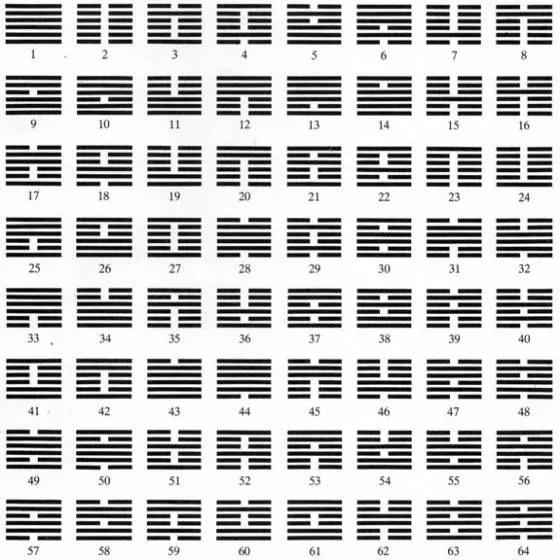
A hexagram is a six-sided star shape formed by two overlapping equilateral triangles. In the context of the I Ching, it refers to a symbol composed of six stacked horizontal lines, each either broken (yin) or unbroken (yang), used in divination.
This image shows all 64 hexagrams of the I Ching (also called the Book of Changes), a foundational text in Chinese philosophy and divination.
Each hexagram has six lines, read from bottom to top. Solid line (—) represents yang, embodying activity, strength, or light. Broken line (– –) represents yin, embodying passivity, receptivity, or darkness.
The hexagram is composed of two trigrams (three-line sections). The lower trigram (lines 1–3) represents the inner situation or the subject. While the upper trigram (lines 4–6) represents the outer environment or influence.
Each hexagram carries a meaning or message, often about:
Current situation: how things are unfolding.
Potential outcome: what may result if the current path continues.
Advice or warning: guidance for action or attitude.
The I Ching is often used in novels for divination scenes, where a character might cast yarrow stalks or coins to form a hexagram, then read its meaning as guidance or a prophecy.